2026-10-16
Content
Cloth-Base Tape is widely used in industrial, maintenance, and heavy-duty applications due to its superior mechanical strength and flexibility. Unlike plastic-based or paper-based adhesive tapes, its performance advantages come from a reinforced fabric structure combined with pressure-sensitive adhesive systems. Understanding these technical differences helps engineers and procurement professionals select the correct solution for demanding environments.
According to recent updates in adhesive tape testing methodologies published by international standards organizations between 2024 and 2025, reinforced carrier materials such as woven or non-woven cloth significantly improve tensile strength and conformability compared to polymer-only backings.
Source: ISO 29862 – Rubber and Plastics Determination of Tensile Strength
Cloth-Base Tape consists of a textile carrier, typically cotton or synthetic fabric, coated with a pressure-sensitive adhesive. The cloth layer acts as a mechanical reinforcement, while the adhesive provides bonding to various surfaces.
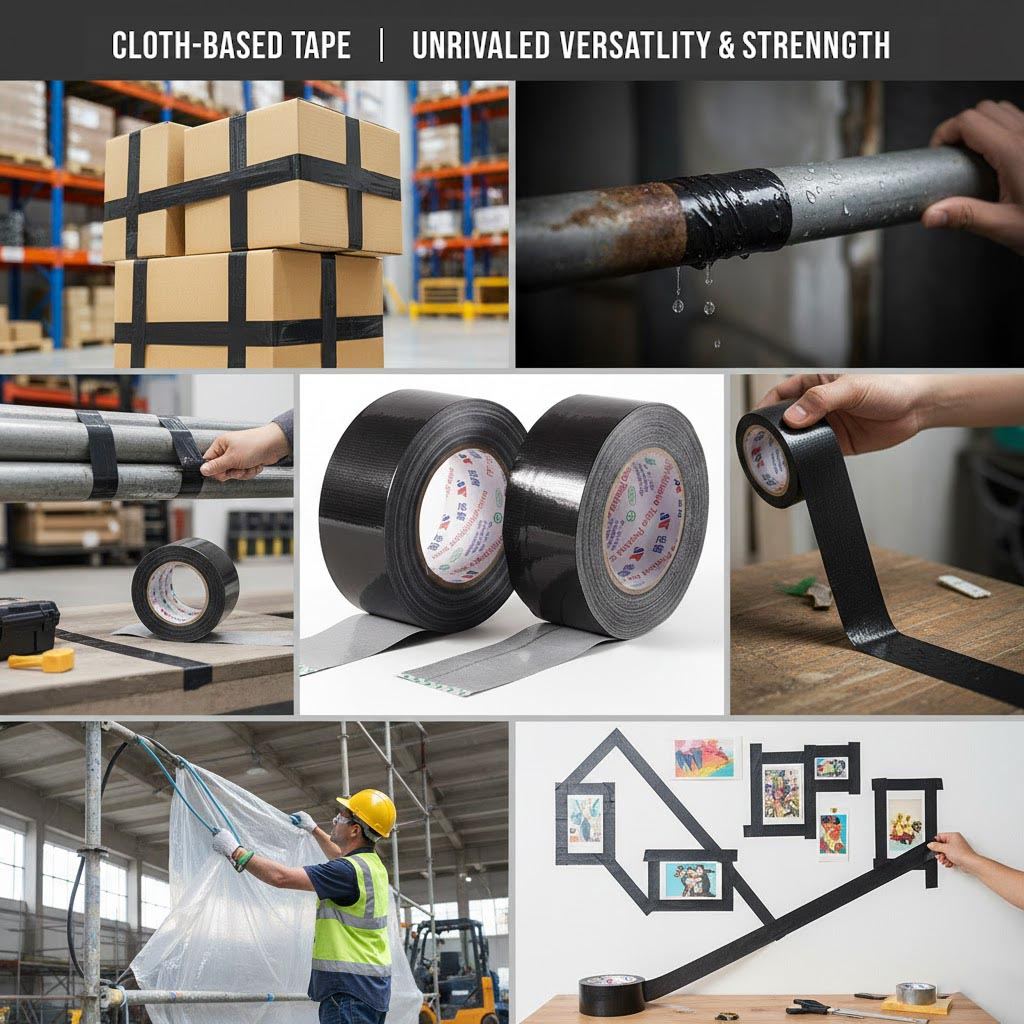
The woven structure distributes stress across multiple fiber directions, improving tear resistance while allowing the tape to bend and stretch without cracking.
| Tape Type | Structural Reinforcement | Flexibility |
| Cloth-Base Tape | Woven Fabric | High |
| Plastic Film Tape | None | Moderate |
| Paper Tape | Cellulose Fiber | Low |
Due to fabric reinforcement, Cloth-Base Tape exhibits higher tensile and tear strength, making it suitable for load-bearing and high-stress applications.
Cloth carriers allow the tape to conform to curved, textured, or uneven surfaces without losing adhesion.
| Performance Aspect | Cloth-Base Tape | Film Tape |
| Tear Resistance | High | Low |
| Surface Conformability | Excellent | Limited |
Most Cloth-Base Tape products use pressure-sensitive adhesive systems engineered for immediate bonding and long-term holding power.
Adhesive chemistry influences initial tack, shear resistance, and durability under environmental stress.
| Adhesive Property | Low-Performance Formulation | Optimized Formulation |
| Initial Tack | Moderate | High |
| Shear Resistance | Low | High |
In industrial environments, Cloth-Base Tape is used for bundling, temporary fixation, surface protection, and repair tasks where mechanical stress is present.
The fabric backing absorbs vibration and impact energy better than rigid carriers, reducing failure under dynamic loads.
| Application Environment | Stress Level | Suitability |
| Industrial Maintenance | High | Excellent |
| Light Packaging | Low | Acceptable |
Cloth-based structures maintain adhesion and flexibility under varying humidity and temperature conditions, making them suitable for short- to medium-term outdoor use.
At elevated temperatures, cloth carriers resist deformation better than paper-based tapes, while adhesive formulation determines thermal limits.
According to ASTM performance evaluations updated in 2024, reinforced carrier tapes demonstrate improved dimensional stability under heat exposure compared to unsupported films.
Source: ASTM D3330 – Peel Adhesion of Pressure-Sensitive Tape
Selection should be based on load requirements, environmental exposure, surface type, and expected service duration.
Evaluating performance data ensures that the selected Cloth-Base Tape meets operational requirements without overengineering.
The woven fabric distributes force across fibers, reducing localized tearing.
No, flexibility improves surface contact and bonding consistency.
Yes, the fabric structure absorbs mechanical shock and vibration.
It performs well in variable conditions, depending on adhesive formulation.
Carrier strength, adhesive chemistry, and environmental exposure.

Our company has been engaged in the tape manufacturing industry for more than 20 years, and has been focusing on various types of aluminum foil tapes, foam tapes, refrigerator tapes, etc.
IsabelLina
Email:[email protected]
Mobile/Whatsapp: +86 190 3379 1110
Mars Gong
Email:[email protected]
Mobile/Whatsapp: +86 159 5136 0053
Address: West side of Yingbin Avenue and south side of hengwang packaging. Suqian Economic and Technological Development Zone,Jiangsu Province
Copyright © Jiangsu Shixin Adhesive Tape Product Co., Ltd. All Rights Reserved. Custom ODM Refrigerator Foil Adhesive Tapes Manufacturers