2026-09-18
Content
The EU Packaging and Packaging Waste Regulation, Regulation (EU) 2025/40, started to apply on 12 August 2026.
For BOPP carton sealing tape, paper tape and other pressure-sensitive packaging tapes, this does not mean that one specific tape material has suddenly been prohibited. Nor does it create a universal “PPWR certificate” that every roll of packaging tape must obtain.
The more important change is happening at the packaging-system level. European buyers are increasingly expected to consider how tape, cartons, films, labels and other packaging components work together in terms of material use, recyclability and technical documentation.
As a result, packaging tape procurement is moving beyond one question: “Does the tape seal the carton?” Buyers increasingly need to ask what the backing material is, what adhesive system is used, whether the tape could interfere with sorting or recycling of the main packaging material, whether material consumption can be reduced without compromising package integrity, and whether the supplier can provide reliable technical information.
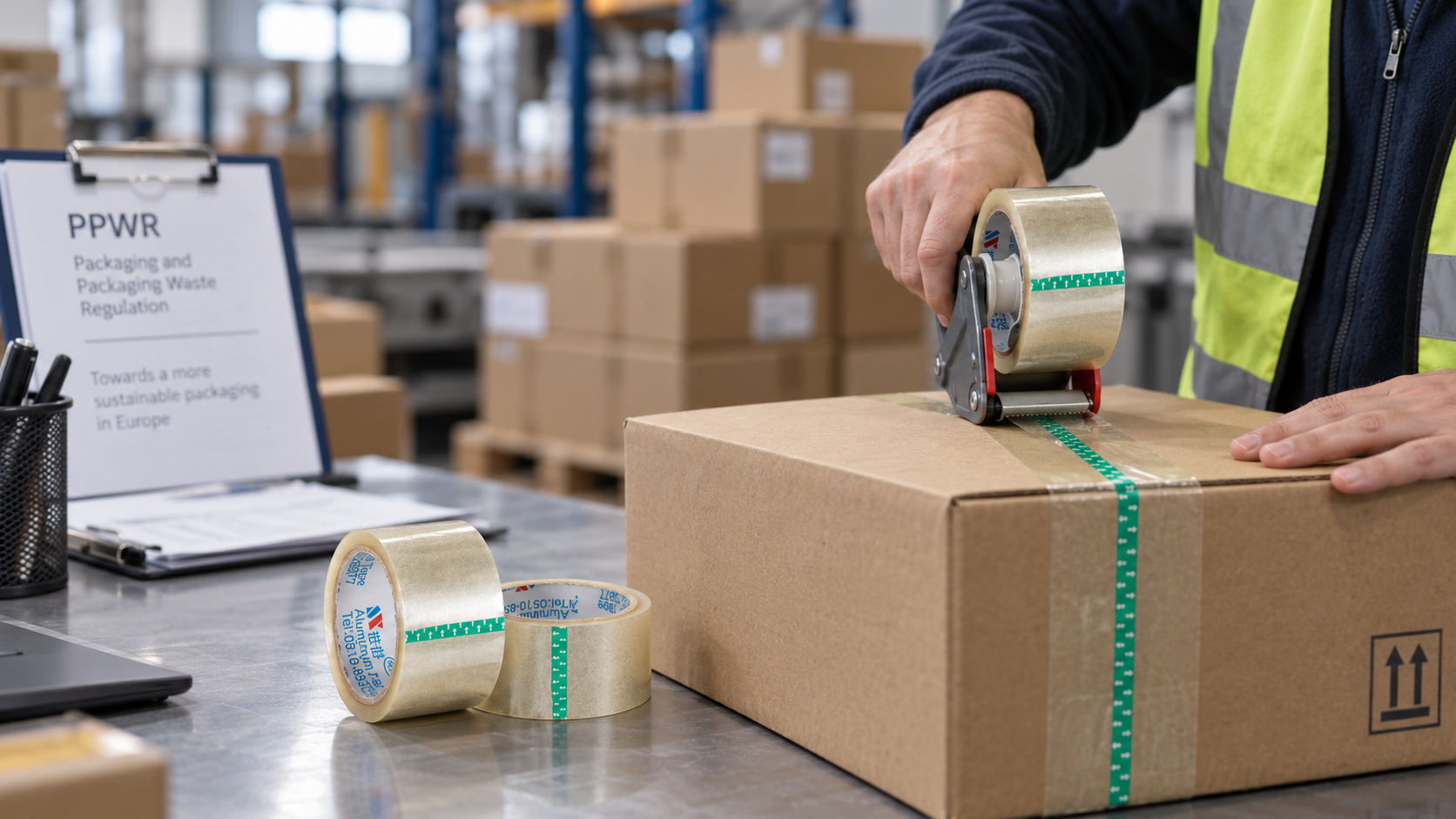
PPWR entered into force in February 2025 and has applied across the EU since 12 August 2026. It introduces a harmonised framework covering packaging prevention, recyclability, material use, labelling, reuse and producer responsibilities.
One of the principles most relevant to industrial packaging is that packaging should be designed to minimise unnecessary weight and volume while remaining capable of protecting the product and performing effectively through manufacturing, filling, storage and transport.
The regulation’s design-for-recycling framework also considers whether packaging components interfere with established collection, sorting and recycling processes. For adhesives, this makes compatibility with the recycling process an increasingly important technical consideration.
No. The regulation does not simply state that BOPP carton sealing tape is prohibited.
The more useful question is not “Is BOPP tape PPWR compliant?” It is: “How does this tape behave as part of our specific packaging system and recycling route?” This distinction matters.
From 2030, PPWR progressively introduces recyclability performance requirements for packaging, with grades A, B and C forming part of the regulatory framework. Detailed assessment criteria depend on delegated and implementing measures.
For packaging buyers, 2026 should therefore be viewed as the beginning of a transition in specification and supplier-management practices rather than a sudden ban on conventional packaging materials.
Traditional carton sealing tape purchasing focuses heavily on thickness, width, roll length, peel adhesion, tack, colour, printing and price. These parameters remain important.
However, buyers serving the European market increasingly need to look at the relationship between the tape and the primary packaging material. For a corrugated carton, that may include questions such as whether the tape construction interferes with the intended recycling process, how the adhesive behaves during processing, whether more tape is being applied than technically necessary, and whether tape width, backing thickness or adhesive coat weight can be optimised while maintaining reliable carton closure.
This shifts the discussion from an isolated product specification toward a system consisting of the tape, carton, packing process and end-of-life route.
PPWR increases the importance of technical documentation throughout the packaging value chain. A tape supplier is not automatically responsible for completing the customer’s entire PPWR assessment. However, downstream packaging manufacturers and brand owners may increasingly request upstream data to support their own compliance work.
Useful information can include backing material, carrier thickness, finished tape thickness, adhesive chemistry, relevant construction information, technical data sheets, test methods, REACH or other applicable material declarations, restricted-substance information and traceability information.
For procurement teams, a supplier that clearly distinguishes film thickness from finished tape thickness and can explain the adhesive construction is more useful than one offering only a generic “50 micron tape.”
Material reduction does not mean using the thinnest possible tape. An under-specified tape can lead to carton opening, damaged packages or product loss, which creates additional material and environmental impact. An over-specified tape, however, may add unnecessary material and cost.
The appropriate specification should therefore be based on actual operating conditions, including carton surface, package weight, transport environment, packing-line speed, storage temperature, tape width, adhesive requirements and application method.
Shixin’s existing BOPP sourcing guidance already separates carrier thickness from total finished tape thickness, helping buyers compare constructions rather than relying on a single micron figure.
A common assumption is that replacing plastic tape with paper tape automatically solves packaging sustainability requirements. The reality is more complex.
Paper tapes can contain coatings, reinforcement layers and adhesive systems that also need to be considered as part of the packaging structure. Likewise, a BOPP tape should not be rejected solely because its backing is polypropylene.
The relevant question is how the complete package performs during use and at end of life. Material names are only the starting point.
For suppliers serving European customers, purchasing questionnaires are likely to become more detailed. In addition to price, MOQ and lead time, buyers may increasingly request material composition, technical data, restricted-substance information, recycling-related supporting information, test methods, traceability and custom specification capability.
This changes supplier competition. Clear technical information, consistent specifications and the ability to discuss packaging applications can become as important as the quoted cost per roll.
Jiangsu Shixin Adhesive Tape Product Co., Ltd. (Shixin Tape) supplies PP-based packaging tapes including BOPP carton sealing tape.
Specifications can be discussed according to carton material, package weight, operating temperature, manual or automatic carton sealing, tape width, roll length, film thickness, finished thickness and adhesive requirements.
For companies reviewing packaging under PPWR, the useful question is not simply “Do you have a PPWR tape?” A better approach is to share the packaging structure and operating conditions, determine what technical and material information is available for the tape, and assess the finished packaging system under the customer’s applicable compliance framework.
No. PPWR does not impose a general ban on BOPP carton sealing tape. The finished packaging system and applicable recyclability requirements need to be assessed.
No universal PPWR tape certificate is established by the regulation. Buyers should be cautious about replacing a packaging-system assessment with a simple marketing claim.
Not necessarily. Backing materials, coatings, reinforcement, adhesives and the complete packaging structure all need to be considered.
Tape can form part of a packaging unit, and its backing and adhesive may influence sorting, recycling efficiency or recycled-material quality. Buyers may therefore request more technical information from suppliers.
Useful information includes carton or packaging substrate, package weight, sealing method, transport conditions, operating temperature, target width and thickness, roll length and required technical documentation.
Discuss Your Packaging Application
Share your carton type, package weight, sealing equipment and target tape specification. Shixin can support specification discussions based on the actual packaging process and application requirements.

Our company has been engaged in the tape manufacturing industry for more than 20 years, and has been focusing on various types of aluminum foil tapes, foam tapes, refrigerator tapes, etc.
IsabelLina
Email:[email protected]
Mobile/Whatsapp: +86 190 3379 1110
Mars Gong
Email:[email protected]
Mobile/Whatsapp: +86 159 5136 0053
Address: West side of Yingbin Avenue and south side of hengwang packaging. Suqian Economic and Technological Development Zone,Jiangsu Province
Copyright © Jiangsu Shixin Adhesive Tape Product Co., Ltd. All Rights Reserved. Custom ODM Refrigerator Foil Adhesive Tapes Manufacturers