2026-10-16
Content
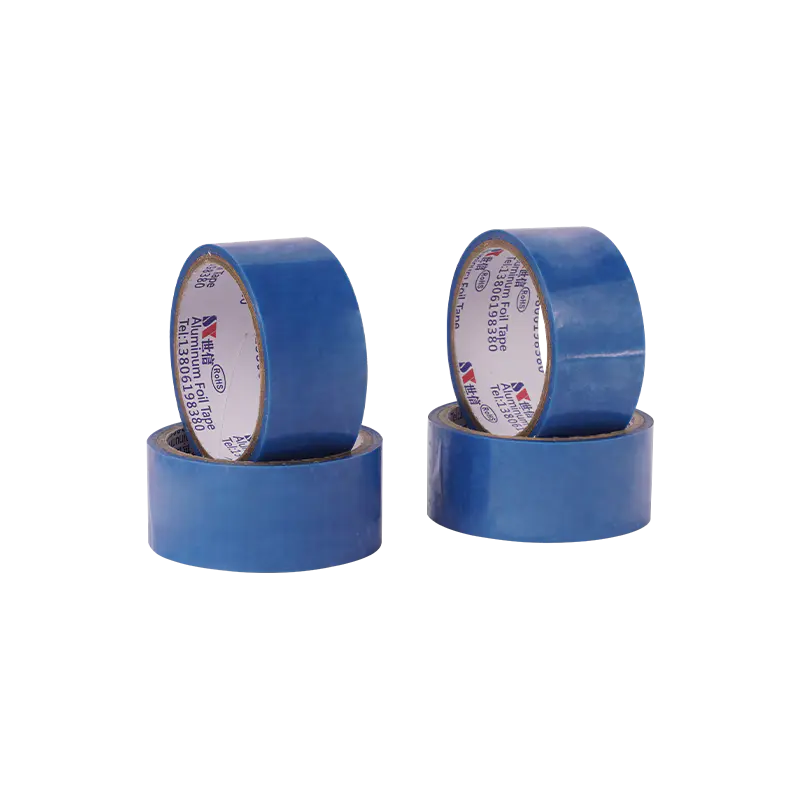
In the world of industrial manufacturing and assembly, not all adhesive tapes are created equal. The Blue PET Adhesive Tape represents a category of high-performance pressure-sensitive tapes engineered for demanding applications where standard products fail. Comprising a blue-tinted polyethylene terephthalate film backing and a sophisticated adhesive system, this tape is a precision tool for process engineers. This technical analysis details its material composition, quantifies its performance advantages, and maps its critical applications across electronics, automotive, and general industry, providing a framework for its specification and strategic sourcing.
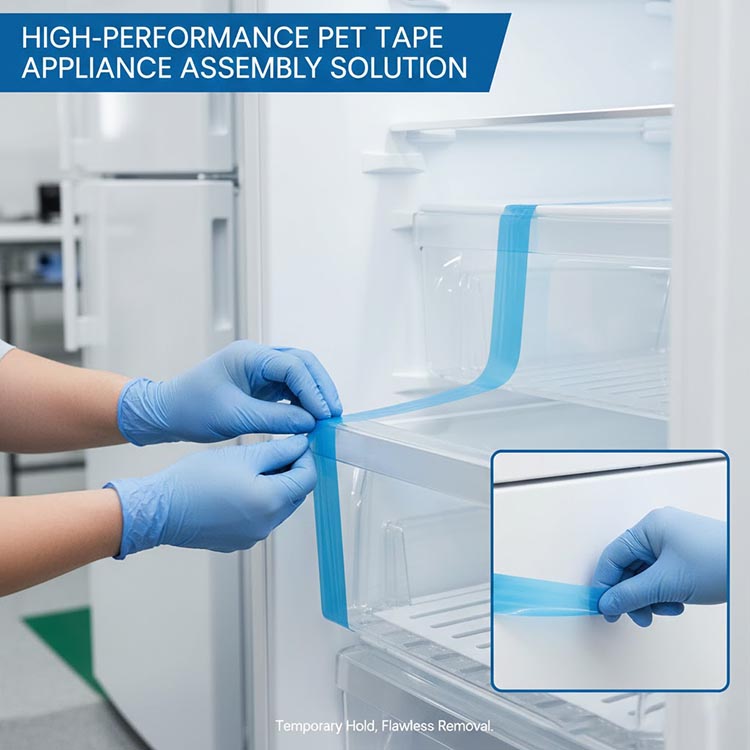
The performance of Blue PET Adhesive Tape is a direct result of its layered construction, where each element serves a specific engineering function.
The blue PET film is not merely a colored carrier; it is a high-strength, biaxially oriented polyester film. Its key engineered properties include:
The adhesive layer converts the inert film into a functional tape. For industrial blue PET tape, the dominant chemistry is acrylic-based, chosen for its balanced performance:
This is a primary domain where the tape's properties are non-negotiable.
The tape acts as a selective barrier in finishing processes.
Its robustness lends itself to diverse roles.
Selecting the correct tape requires understanding key performance indicators and how blue PET tape compares to alternatives.
Understanding the specifications (thickness, adhesion, temperature resistance) for a Blue PET Adhesive Tape is essential for qualification.
According to the latest industry research compiled by the Pressure Sensitive Tape Council, there is a growing demand for tapes with enhanced sustainability profiles without compromising performance. This includes developments in bio-based or recycled PET film backings and solvent-free, UV-cured acrylic adhesives. These innovations aim to reduce the carbon footprint of industrial tapes while maintaining or improving key metrics like temperature resistance and adhesion stability, directly impacting future specifications for products like blue PET tape.
A clear Blue PET Tape compare to other colored or clear PET tapes in performance reveals its niche. More importantly, comparing it to entirely different tape types clarifies its value proposition.
| Performance Metric | Blue PET Tape (Acrylic Adhesive) | PVC Electrical Tape | Crepe Paper Masking Tape | Polyimide (Kapton) Tape |
|---|---|---|---|---|
| Tensile Strength / Dimensional Stability | High / Excellent | Low / Poor (Elastic, stretches) | Very Low / Poor | Very High / Excellent |
| Temperature Resistance (Continuous) | Up to 150°C | Up to 80°C (PVC can degrade) | Up to 120°C (short term) | Up to 260°C+ |
| Chemical/Solvent Resistance | Excellent | Fair to Good | Poor | Outstanding |
| Clean Removal / Residue | Excellent / Minimal | Poor / Often leaves oily residue | Fair / Can leave paper fibers | Excellent / Minimal |
| Dielectric Strength | Excellent | Good | None (Conductive) | Excellent |
| Relative Cost | Moderate (High Value) | Low | Very Low | Very High |
| Primary Application Justification | High-reliability masking, insulation, and bonding in demanding environments. | Basic wire insulation and bundling where cost is primary and high performance is not required. | Low-temperature paint masking on porous surfaces. | Ultra-high-temperature applications (>200°C) in electronics and aerospace. |
The selection process is iterative: define the application's mechanical, thermal, and environmental demands; identify tapes with specifications that exceed these requirements; then conduct real-world validation tests (e.g., a heat-age and peel test for soldering applications).
Off-the-shelf products don't always fit. Production engineers often need to source custom-width or printed blue PET adhesive tape for manufacturing. Common custom requirements include:
This is where partnering with a technically capable manufacturer becomes critical. A supplier with deep expertise in polymer processing and adhesive formulation is more than a vendor. Their dedicated technical team can collaborate on material selection, prototype custom solutions, and ensure that the specifications (thickness, adhesion, temperature resistance) are not just numbers on a datasheet but are consistently delivered in every production batch through rigorous quality control. This ability to translate a unique application challenge into a reliable, manufacturable product is the hallmark of a true engineering partner in the supply chain.
The Blue PET Adhesive Tape is a paradigm of engineered materials solving industrial problems. Its value lies in its predictable, high-performance characteristics—strength, thermal stability, chemical resistance, and clean removal—which directly contribute to manufacturing reliability, product quality, and process efficiency. For engineers and procurement specialists, understanding its applications and advantages enables its effective deployment as a strategic tool, optimizing assembly processes and protecting valuable components.
While often used for visual process control and differentiation (answering the question of Blue PET Tape compare to other colored or clear PET tapes), the blue color can be functional. It may incorporate dyes or pigments that block specific light wavelengths to protect light-curing adhesives or light-sensitive components. In some formulations, the colorant is part of a compound that provides static-dissipative properties, preventing electrostatic discharge damage to sensitive electronics.
To confirm a tape can withstand high-temperature SMT reflow soldering processes, you must conduct or review a thermal reliability test. The tape should be applied to a test coupon (like a PCB with copper traces), subjected to a standard reflow profile (e.g., JEDEC J-STD-020 with peaks at 240-260°C), and then evaluated. Key pass/fail criteria include: no adhesive residue on the coupon (tested with adhesive residue tape), no significant shrinkage or lifting of the tape edges, and no degradation of the tape's backing or adhesive that causes it to become brittle or lose adhesion.
The primary failure modes are adhesive and cohesive. Adhesive failure is when the tape cleanly detaches from the substrate, often due to surface contamination, low surface energy of the substrate, or exceeding the adhesive's temperature or chemical resistance. Cohesive failure is when the adhesive layer itself tears, leaving residue on both the substrate and the backing. This can indicate an adhesive overloaded with plasticizer, exposure to a solvent that breaks it down, or shear forces exceeding its holding power. Selecting the right tape for the environment is key to avoiding these failures.
High-quality acrylic-based Blue PET Adhesive Tape typically has a shelf life of 12 to 24 months from the date of manufacture when stored in its original packaging under recommended conditions: in a cool, dry environment (ideally 15-25°C / 59-77°F), at moderate humidity (35-65% RH), and away from direct sunlight and heat sources. Storing tapes on-end, rather than laying them flat, can prevent deformation of the roll over long periods.
When you need to source custom-width or printed blue PET adhesive tape for manufacturing, provide a comprehensive specification: 1) Application Description: What is the tape being used for? 2) Substrate: What material will it be applied to? 3) Performance Needs: Required peel strength, temperature exposure, chemical exposure, and required lifetime. 4) Physical Dimensions: Desired total thickness, width(s), roll length, and core size. 5) Printing Artwork: If applicable, provide vector-based graphics. The more detailed the requirements, the more accurate the supplier's proposal and sample will be.

Our company has been engaged in the tape manufacturing industry for more than 20 years, and has been focusing on various types of aluminum foil tapes, foam tapes, refrigerator tapes, etc.
IsabelLina
Email:[email protected]
Mobile/Whatsapp: +86 190 3379 1110
Mars Gong
Email:[email protected]
Mobile/Whatsapp: +86 159 5136 0053
Address: West side of Yingbin Avenue and south side of hengwang packaging. Suqian Economic and Technological Development Zone,Jiangsu Province
Copyright © Jiangsu Shixin Adhesive Tape Product Co., Ltd. All Rights Reserved. Custom ODM Refrigerator Foil Adhesive Tapes Manufacturers