2026-10-23
Content
In modern industrial applications — ranging from HVAC systems and automotive engine compartments to electronic thermal management and building fireproofing — the integrity of seals and thermal barriers is directly tied to system efficiency, safety, and longevity. Yet, one of the most overlooked failure points is the humble adhesive tape used to secure insulation, reflect heat, or seal joints.
The performance of conventional acrylic- or rubber-based tapes can decline as temperature, exposure time, substrate, and mechanical stress increase. Sustained heat or repeated thermal cycling may change adhesive flow, peel retention, or backing stability. For demanding applications, the relevant continuous-use temperature, short-term peak exposure, aging behavior, and substrate conditions should be checked for the selected tape construction.
High-temperature foil-tape selection should separate company management-system certification from product performance. ISO 9001 and ISO 14001 describe management systems; temperature, adhesion and mechanical capability must be supported by the TDS, test report and application validation for the specific grade.
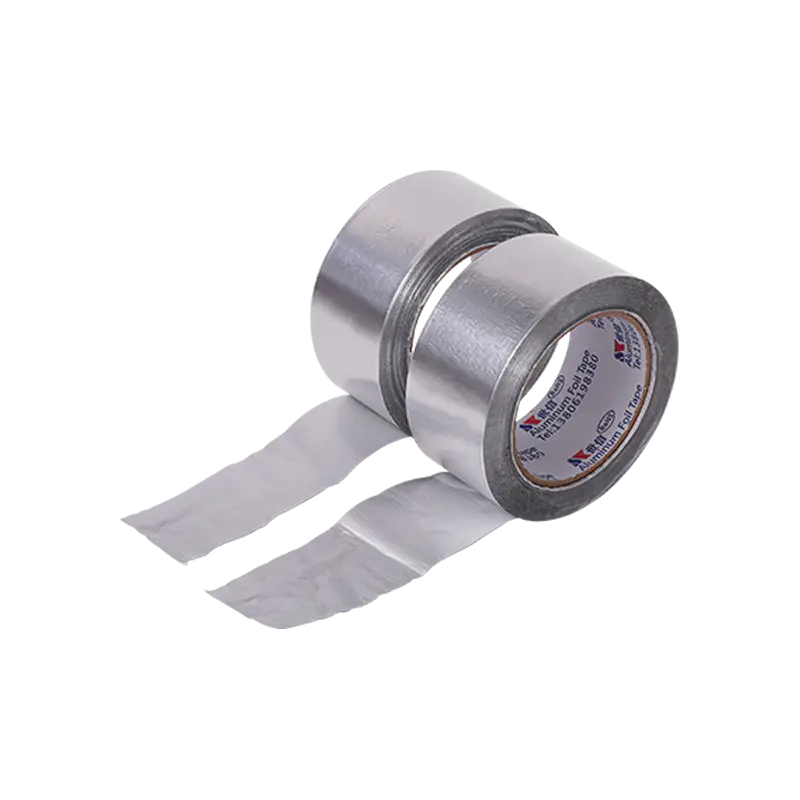
Not all foil tapes are created equal. A genuinely high-performance solution is defined by three interdependent factors: foil substrate quality, adhesive technology, and manufacturing precision. Below is a side-by-side comparison that illustrates how premium-grade material specifications differ from general-purpose alternatives — and why those differences matter in real-world applications.
|
Shixin Product Structure |
Verified Product Data |
Selection Notes |
|
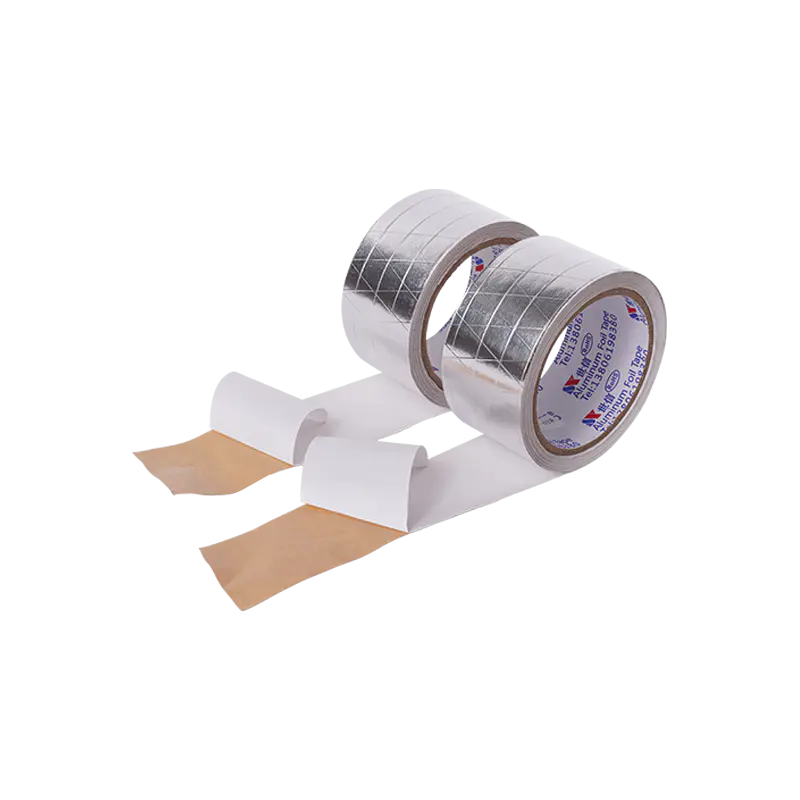
High/low-temperature linered aluminum foil tape |
Silicone adhesive; product information records a temperature range of about -30°C to +250°C. |
Use when the application requires a wider temperature window. Confirm the exact grade, substrate and test conditions before approval. |
|
Automotive high-temperature fiberglass aluminum foil tape (SXGAL-906) |
Silicone adhesive; 170 μm construction; 4 N/cm peel; 260°C instantaneous heat resistance; 250°C × 6 h aging data. |
Developed for automotive wiring-harness, engine-compartment and heat-shielding applications. |
|
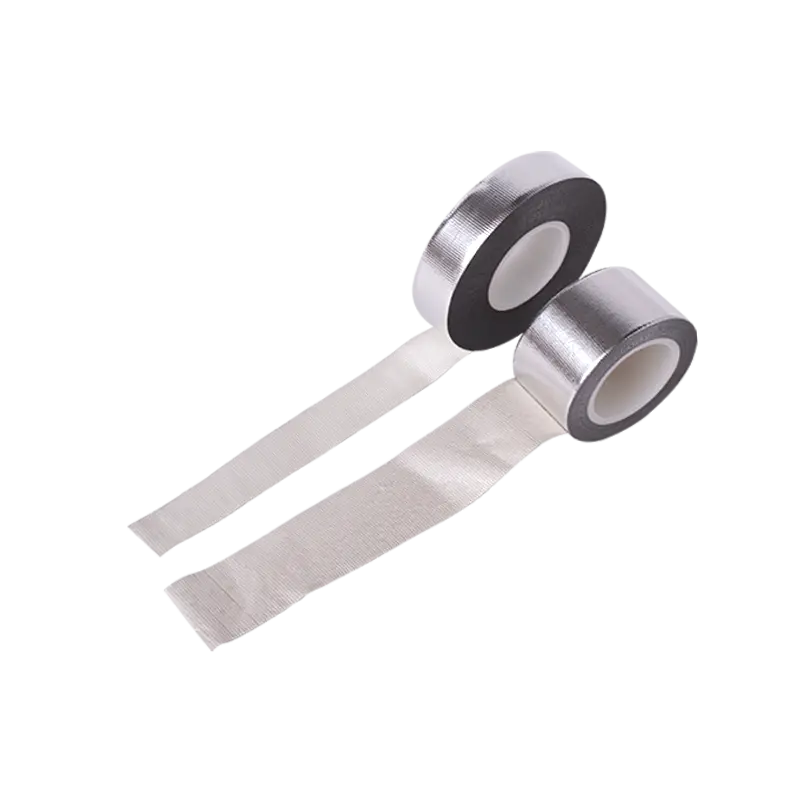
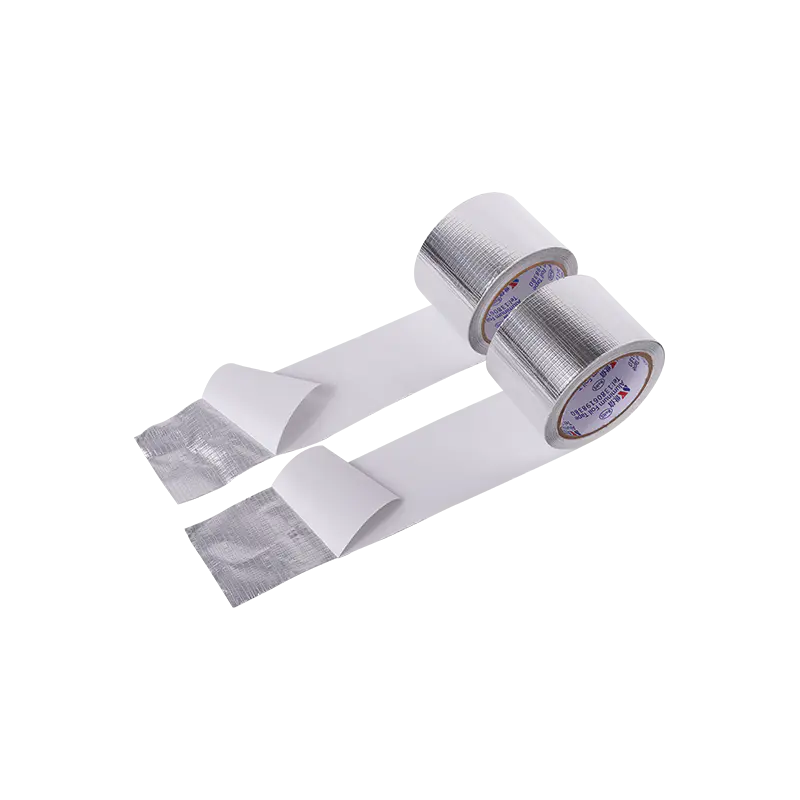
General linered / linerless aluminum foil tapes |
Water-based acrylic, solvent-based acrylic, rubber and hot-melt systems are used across different product structures. |
Temperature and adhesion values vary by grade. Use the TDS or sample test for the selected construction. |
|
Heat-seal aluminum foil tape |
Specific linerless heat-seal grade: 100°C × 100 h heating-wire adhesion; 72 h boiling-water resistance. |
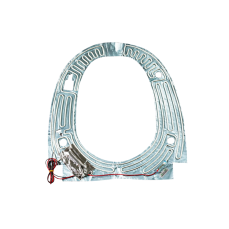
Used for PVC heating-wire heat sealing in refrigerators, freezers and other heating products. |
Key takeaway: High-temperature aluminum foil tape should be selected by product structure, adhesive system, verified temperature exposure and application method. Shixin has different grades for general foil-tape use, wider high/low-temperature conditions, automotive heat shielding and heat-seal applications; use the corresponding product data rather than one universal “premium” benchmark.
ISO 9001 and ISO 14001 certifications are not mere paperwork — they represent a disciplined, audited framework for quality management and environmental responsibility. For high-temperature aluminum foil tapes, this means:
In short, ISO 9001 and ISO 14001 can support process discipline and traceability, but they do not by themselves certify the temperature capability of a specific tape. Product performance should be verified with grade-specific data.
High-temperature aluminum foil tape is widely adopted across several demanding sectors:
Across these applications, aluminum foil tape can contribute to surface protection, seam sealing, moisture control and heat reflection. Exact reflectivity, barrier performance and heat-transfer behavior depend on the foil surface, construction, adhesive layer and test method.
When selecting a high-temperature aluminum foil tape, always evaluate the full system requirements — not just peak temperature, but also dwell time, mechanical stress, substrate surface energy, and regulatory environment. A tape that survives 200°C for 10 minutes is fundamentally different from one that maintains adhesion at 150°C for 10,000 hours. The right choice begins with clear specifications and is confirmed through certified, verifiable performance data.
Understanding the technical anatomy of a high-temperature aluminum foil tape is essential for selecting the right product for your specific application. Performance is not determined by any single attribute, but rather by the synergistic interaction of the foil substrate, the adhesive system, and the reinforcement construction (where applicable). Below, we break down each critical parameter and present a comprehensive comparison across our product series.
The aluminum foil serves as both the thermal reflector and the mechanical backbone of the tape. Key variables include:
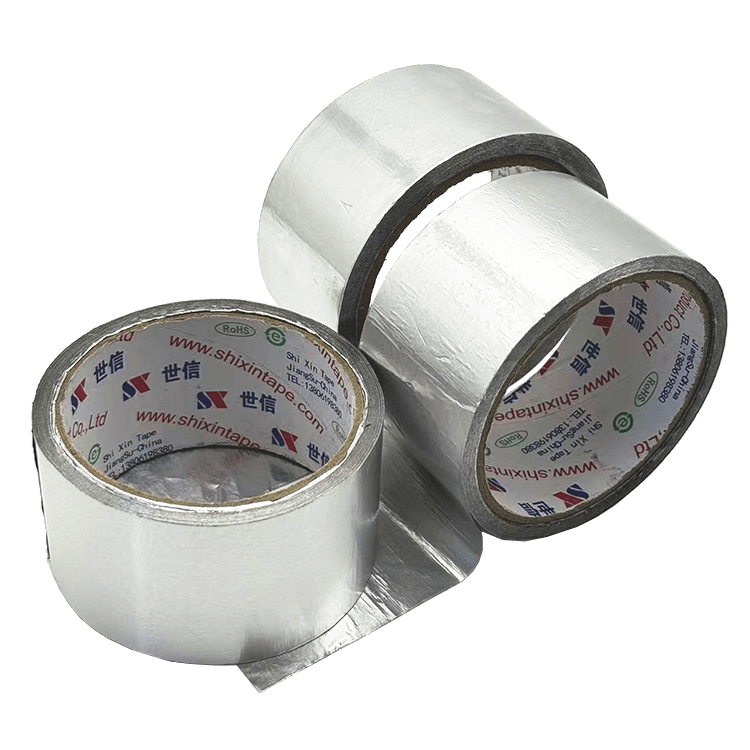
The adhesive is the functional heart of the tape — it must maintain bond strength across the entire service temperature range while resisting creep, outgassing, and oxidative degradation. We offer two primary adhesive chemistries:
|
Product / Adhesive System |
Verified Temperature / Test Information |
Engineering Note |
|
High/low-temperature linered foil tape / silicone |
-30°C to +250°C in Shixin product information. |
Suitable for applications requiring wider high/low-temperature resistance; validate on the actual substrate. |
|
SXGAL-906 automotive fiberglass foil tape / silicone |
260°C instantaneous heat resistance; 250°C × 6 h aging. |
Use the tested grade when high-temperature automotive shielding is required. |
|
Acrylic / rubber / hot-melt foil tape grades |
Temperature capability depends on the specific formulation and construction. |
Do not infer one universal service temperature from the adhesive family alone. |
|
Heat-seal adhesive foil tape |
100°C × 100 h heating-wire adhesion; 72 h boiling-water resistance for the referenced linerless heat-seal grade. |
Heat-activated construction; selection depends on heating wire, substrate and sealing process. |
Selection guidance: Acrylic, rubber, hot-melt and silicone systems serve different applications. Select the adhesive by substrate, continuous/short-term temperature, required unwind and mechanical conditions, then confirm the chosen grade through its TDS and application testing.
For applications requiring exceptional tensile strength, tear resistance, or dimensional stability, we offer reinforced variants where the aluminum foil is laminated to a supporting scrim or film. The choice of reinforcement directly impacts the tape's mechanical behavior:
|
Reinforcement Type |
Typical Construction |
Main Mechanical Benefit |
Typical Shixin Application Direction |
|
Fiberglass |
Aluminum foil + laminating layer + fiberglass cloth + adhesive + liner |
Improved tear and puncture resistance; better dimensional stability than unsupported foil. |
Pipe/roof/insulation protection and high-temperature shielding, depending on grade. |
|
FSK |
Aluminum foil + scrim + kraft + adhesive + liner |
Reinforcement plus kraft facing for insulation-seam and vapor-barrier applications. |
HVAC duct wrapping, insulation seam sealing and vapor-barrier joints. |
|
SS reinforced |
Aluminum foil + scrim + film + adhesive + liner |
Composite reinforcement with a balance of strength and flexibility. |
Glass wool, rock wool and duct-board seams; rigid/flexible duct applications. |
Based on the substrate, adhesive, and reinforcement parameters described above, we offer the following comprehensive product series to address the full spectrum of high-temperature sealing and protection requirements:
While aluminum foil tapes form our core expertise, many thermal and acoustic management challenges require complementary materials. Our extended product portfolio includes:
By offering this breadth of materials, we enable our customers to consolidate suppliers, reduce procurement complexity, and ensure compatibility between adjacent materials in multi-layer insulation systems.
Selecting the right high-temperature aluminum foil tape requires a systematic evaluation of your application's thermal profile, mechanical demands, surface conditions, and environmental exposure. The technical parameters and product series outlined above provide a framework for that decision. For assistance in matching a specific product to your performance criteria, we encourage you to consult with our technical team — we are here to ensure you get not just a tape, but the right engineered solution for your application.
In the adhesive tape industry, product quality is inseparable from manufacturing capability. A tape's performance is ultimately determined by the precision of the coating line, the consistency of the curing oven, and the rigor of the quality control laboratory. We invite you to look beyond the product datasheet and understand the manufacturing infrastructure that stands behind every roll we deliver.
Our journey began in 2005, and over two decades of dedicated growth, we have evolved from a small-scale producer into a high-tech enterprise that integrates research and development, production, and global sales. Today, our manufacturing campus spans nearly 12,000 square meters of factory floor space, housing multiple dedicated production lines for aluminum foil coating, laminating, slitting, and custom converting.
With a committed team of 100 employees, including engineers, quality control specialists, and production technicians, we maintain a vertically integrated operation that gives us full control over every stage of the manufacturing process — from raw material receiving to finished goods dispatch. This scale enables us to operate with both agility (responding to custom orders with short lead times) and stability (maintaining consistent output even during peak demand seasons).
We believe that quality is not a claim — it is a documented, audited, and continuously improved process. Our operations are certified to the following internationally recognized standards:
|
Certification |
Scope & What It Means for You |
|
ISO 9001 |
Quality Management System — ensures that our processes for production, inspection, non-conformance handling, and continuous improvement meet international best practices. Every batch is traceable, and every corrective action is documented. |
|
ISO 14001 |
Environmental Management System — confirms our commitment to reducing waste, managing chemical usage responsibly, and minimizing our environmental footprint. This is increasingly important for customers with corporate sustainability goals. |
|
SGS Certification |
Third-party verification of product performance and safety. SGS testing validates that our tapes meet the claimed physical properties (peel adhesion, tensile strength, temperature resistance) and do not contain restricted substances. |
|
RoHS Compliance |
Restriction of Hazardous Substances Directive (EU 2011/65/EU) — guarantees that our tapes are free from lead, mercury, cadmium, hexavalent chromium, PBBs, and PBDEs. Essential for electronics, automotive, and export markets. |
|
REACH Compliance |
Registration, Evaluation, Authorization, and Restriction of Chemicals (EC 1907/2006) — ensures that all substances used in our adhesives and coatings are registered and within permitted concentration limits. We provide full SVHC disclosure upon request. |
Why this matters to you: These certifications are not badges on a wall — they represent an operational discipline that translates into fewer quality surprises, smoother regulatory approvals for your finished products, and reduced audit fatigue when your own customers request supply chain documentation.
Many adhesive tape users face the challenge of managing multiple suppliers for different material families, leading to increased procurement overhead, inconsistent quality, and compatibility issues at the interface between tapes and foams or films. We address this by offering a unified product ecosystem under one roof:
|
Product Family |
Key Offerings |
Typical Synergy with Foil Tapes |
|
Aluminum Foil Tapes |
Without Liner / With Liner / Laminated / Fiberglass Reinforced / FSK Reinforced / SS Reinforced / Automotive High-Temp / Heat Seal |
The core product — used as the primary sealing and heat-reflecting layer. |
|
PU / PE / NBR Foam Solutions |
Closed-cell and open-cell foams in various densities and thicknesses; available with single- or double-sided adhesive |
Used as gasketing beneath foil tapes to create a conformable seal on uneven surfaces; or as acoustic damping layers behind foil facings. |
|
Film Tapes Solutions |
PET (polyester), polyimide (Kapton-type), and PVC film tapes; with acrylic or silicone adhesives |
Provide electrical insulation, dielectric barriers, or high-temperature masking where metallic foil is not suitable (e.g., transparent or non-conductive requirements). |
This integrated portfolio allows you to:
Our quality assurance framework operates at three levels:
This three-tier framework is intended to support consistency with the agreed product specification and provide records for batch review.
As a high-tech enterprise, we maintain an active R&D program focused on:
Our R&D team collaborates directly with customer engineering departments on custom projects, offering tailored solutions that address application-specific requirements — whether that means a unique width, a specialized adhesive pattern, or a custom release liner for automated dispensing equipment.
Behind every roll of tape we ship is a manufacturing system built on experience, certified by international standards, and continuously refined through research and customer feedback. We do not simply sell adhesive tapes — we provide the production capacity, technical expertise, and quality assurance that allow our customers to focus on their core business, confident that the materials beneath their insulation, shielding, and sealing systems will perform as expected. We welcome the opportunity to demonstrate our capabilities through a facility visit, a sample trial, or a technical discussion about your specific application requirements.
For industrial buyers, supplier evaluation is better based on documented product specifications, manufacturing capability, quality records, application experience, and communication during qualification. The following section summarizes the capabilities and evidence that can be reviewed for a project.
We are proud to count among our long-term partners a distinguished group of global brands spanning the home appliance, electronics, and industrial equipment sectors. These organizations — recognized worldwide for their stringent supplier qualification processes — have selected us as a trusted source for adhesive tape solutions:
These partnerships are not awarded lightly. Each of these companies conducted rigorous supplier audits, performance trials, and ongoing quality monitoring before entrusting us with their production-critical materials. Their continued trust — in many cases spanning over a decade — is the strongest validation of our reliability.
One of the most frequently cited challenges for procurement professionals is balancing cost reduction with quality preservation. We address this through a combination of economies of scale and a localized, integrated supply chain that eliminates unnecessary cost layers.
The following case replaces a generic supplier-cost comparison with a result recorded in Shixin’s internal refrigerator application information. The 10-15% figure applies to this specific condenser-tube tape solution and should not be generalized to all products or customers.
|
Application Case |
Original Production Issue |
Shixin Response & Recorded Result |
|
Refrigerator condenser-tube laminated linerless foil tape |
Seasonal temperature changes affected rubber-adhesive tack and unwind, sometimes causing difficult unwind or breakage. |
Shixin developed an anti-stick/release layer compatible with different adhesive systems. Several refrigerator manufacturers improved seasonal application stability; the internal case record reports about 10-15% lower tape procurement cost for this specific solution. |
Case note: The recorded 10-15% procurement-cost reduction comes from one refrigerator condenser-tube project after release-layer and adhesive-system optimization. It is not a general comparison with European suppliers and does not imply that every product or application will achieve the same saving.
Product approval should be based on the customer requirement, the selected product specification and actual test evidence. The checklist below identifies parameters to verify; it is not a universal minimum-performance guarantee for all Shixin foil tapes.
|
Parameter to Verify |
Why It Matters |
Recommended Evidence |
Practical Note |
|
Peel adhesion |
Bonding performance changes with substrate and adhesive system. |
TDS / batch test / application sample |
Test on the actual steel, aluminum, copper, foam or coated surface used in production. |
|
Tensile / tear performance |
Reinforced and unsupported foil constructions behave very differently. |
TDS / tensile test |
Do not use one tensile value as a universal benchmark for all foil-tape families. |
|
Temperature resistance |
Continuous use and short-term peak exposure are different conditions. |
Product-specific aging or temperature test |
Use verified data for the selected grade, e.g. SXGAL-906 or the high/low-temperature linered grade. |
|
Thickness and tolerance |
Affects handling, conformability and converting. |
Product specification / incoming inspection record |
Shixin general information lists weight/thickness tolerance at ±10% unless a specific product agreement states otherwise. |
|
Compliance documents |
Required by different markets and customers. |
Applicable RoHS / REACH / SGS report; ISO management-system certificates |
Confirm that the document scope matches the actual product supplied. |
Performance should be evaluated against the agreed specification for the selected product and the applicable test records. Process control, inspection, and third-party documentation can be used as supporting evidence where available.
We view every customer relationship as a technical partnership, not a simple purchase order. Our support model is designed to help you succeed at every stage of the product lifecycle:
While transactional relationships focus on price per roll, we believe in creating value through collaboration and shared growth. Our longest customer relationships now exceed fifteen years — a duration that reflects our commitment to continuous improvement, transparent communication, and mutual success.
When you choose us as your adhesive tape supplier, you are not simply purchasing a commodity. You are gaining a manufacturing partner with:
For supplier evaluation, we recommend reviewing the selected product specification, available test data, samples, and application results under your own process conditions. This provides a more practical basis for comparison than broad marketing claims.
High-temperature aluminum foil tape is a remarkably versatile material, yet its optimal performance depends on selecting the right product grade for the specific application environment. The same tape that excels on a smooth metal duct surface may perform poorly on a flexible, low-energy insulation blanket. In this section, we examine the most common application scenarios in detail — explaining the technical demands of each, the performance criteria that matter most, and the tape configurations best suited to meet those challenges.
Heating, ventilation, and air conditioning (HVAC) systems represent the single largest application volume for aluminum foil tapes. Within this sector, three distinct use cases dominate:
Longitudinal seams and transverse joints in rectangular or spiral ducts must be sealed to prevent air leakage, which can account for 10–30% of energy loss in poorly sealed systems. The tape must conform to the duct profile, resist vibration-induced fatigue, and maintain adhesion across seasonal temperature swings (−10°C to +70°C in most climates).
Flexible fiberglass or mineral wool insulation blankets are wrapped around ductwork and secured with "W" pins or stick-pins, which are then capped with a foil tape disc. The tape must hold the insulation firmly against the duct surface, even under negative pressure (return air) conditions.
Flexible duct sections (non-metallic, spiral-wire reinforced) require a tape that can accommodate expansion, contraction, and moderate flexing without cracking or delaminating. Fiberglass reinforcement provides the necessary tensile strength to bridge the wire helix gaps.
Under-hood temperatures in modern vehicles regularly reach 120–150°C, with peak radiant heat from turbochargers and exhaust manifolds exceeding 250°C. Aluminum foil tapes are used extensively for two primary purposes:
Strategically placed foil tape on the inner surfaces of hood liners, firewall insulation, and heat shields reflects radiant heat away from sensitive components (electronic control units, sensors, fuel lines). The tape must maintain adhesion on oily, textured surfaces and resist degradation from engine oil and coolant vapors.
Wiring harnesses routed near exhaust components are wrapped with foil tape to reflect heat and prevent insulation melt-through. The tape must be flexible enough to conform to harness branches and stay secure despite vibration.
Appliances such as microwave ovens, electric ovens, induction cooktops, and water heaters incorporate thermal insulation layers to protect outer cabinets and improve energy efficiency. Aluminum foil tape is the standard method for securing these insulation materials during assembly.
|
Application |
Relevant Shixin Structure |
Verified Product Information |
Validation Priority |
|
Refrigerator / freezer heating wire |
Heat-seal aluminum foil tape |
Referenced linerless heat-seal grade: 100°C × 100 h heating-wire adhesion and 72 h boiling-water resistance. |
Heat-seal temperature, heating-wire material, long-term adhesion and humidity/water resistance. |
|
Automotive wiring / engine compartment |
SXGAL-906 fiberglass aluminum foil tape |
Silicone adhesive; 260°C instantaneous heat resistance; 250°C × 6 h aging. |
Temperature exposure time, chemical/moisture conditions, abrasion and installation method. |
|
HVAC / insulation seams |
Linered, linerless, fiberglass, FSK or SS reinforced foil tape |
Multiple adhesive and reinforcement structures are available. |
Substrate, vapor-barrier requirement, conformability, tear strength and field conditions. |
|
Refrigeration tube fixing / sealing |
Linered or linerless aluminum foil tape |
Product information lists use on refrigerator/freezer evaporator and condenser applications; manual and machine use are supported on relevant grades. |
Unwind, adhesion, PU-foam compatibility, temperature and line process. |
Beyond these core applications, aluminum foil tapes may be evaluated for additional thermal-management or masking tasks, but each use should be tied to a product-specific construction and test condition. Applications not covered by Shixin’s current product data should be validated before being presented as a standard recommendation.
In the construction sector, aluminum foil tape serves both functional and safety roles:
Aluminum foil tape is applied over joints in weatherproofing membranes on steel roofs and facades, providing a reflective, impermeable seal that prevents water ingress. The tape must resist UV exposure and maintain adhesion to both the membrane and the underlying steel substrate.
In commercial and high-rise buildings, fire-rated ductwork and structural steel are wrapped with fire-resistant insulation, secured with aluminum foil tape. While the tape itself is not the primary fire barrier, it keeps the insulation in place during fire events, preventing the insulation from sagging or falling off.
Passenger railcars incorporate thick acoustic and thermal insulation layers between the exterior shell and interior panels. Aluminum foil tape is used to fasten these insulation layers and seal the vapor barriers, reducing condensation risks and improving passenger comfort.
Beyond the traditional thermal management roles, aluminum foil tape is increasingly employed in electronics and packaging:
To simplify the selection process, the matrix below maps application categories to recommended product grades and key performance priorities:
|
Application Category |
Suggested Product Direction |
Priority #1 |
Priority #2 |
|
Refrigeration tube fixing |
Linerless / linered aluminum foil tape |
Adhesive and unwind compatibility |
Production-line validation |
|
HVAC duct / insulation seams |
Linered / FSK / SS reinforced foil tape |
Conformability / vapor barrier |
Mechanical strength |
|
Automotive heat shielding |
SXGAL-906 fiberglass / silicone |
Verified temperature exposure |
Chemical / moisture resistance |
|
Heating-wire fixation |
Heat-seal aluminum foil tape |
Heat-seal process compatibility |
Long-term heat / water resistance |
|
Heavy-duty insulation protection |
Fiberglass reinforced foil tape |
Tear / puncture resistance |
Application flexibility |
Every application environment presents a unique combination of thermal, mechanical, and environmental demands. The key to reliable performance lies in matching the tape's properties to the specific stresses it will encounter — not simply selecting the "highest temperature" grade or the "strongest" adhesive, but rather the most balanced configuration for your particular use case. Our technical team is available to review your application drawings, environmental conditions, and performance requirements to recommend a precise product match. We also offer custom sampling for validation testing, ensuring that your selection is confirmed before full-scale production deployment.
In an industry where adhesive tapes are often treated as commodities, we take a fundamentally different view. We believe that every roll of tape we deliver carries with it a responsibility — to perform reliably in your application, to contribute to your operational efficiency, and to support your business growth over the long term. This section outlines our collaborative philosophy, the principles that guide our partnerships, and the practical ways we work alongside our customers to achieve shared success.
We define our role not as a vendor of adhesive products, but as a technical partner invested in your success. This commitment manifests in five core principles:
Our partnership model is designed to be flexible and responsive to your specific needs, regardless of your company size or application complexity. The following table outlines the key touchpoints in a typical collaborative engagement:
|
Engagement Phase |
Our Activities |
Your Benefits |
|
Initial Inquiry & Application Review |
We study your application drawings, operating temperatures, substrate materials, and installation methods. We ask clarifying questions to ensure we fully understand your performance requirements. |
You receive a precise product recommendation, not a generic catalog suggestion. This reduces trial costs and accelerates the qualification process. |
|
Sample Provision & Testing |
We provide free samples (typically 2–5 rolls) for your internal testing. We offer technical datasheets, test reports, and (where needed) third-party certification documents to support your evaluation. |
You validate product performance in your own production environment before committing to volume orders. Risk is minimized. |
|
Trial Order & Process Integration |
We support the integration of our tape into your production process — advising on application techniques, storage conditions, and shelf-life management. We offer on-site support if requested. |
Smooth implementation with minimal disruption to your existing workflows. Our support reduces the learning curve for your production teams. |
|
Volume Supply & Quality Monitoring |
Production scheduling and lead times are confirmed according to order requirements. Customer feedback can be reviewed as part of ongoing quality communication. |
Clearer production planning and quality communication based on the confirmed order and project requirements. |
|
Long-Term Partnership & Innovation |
We share insights on new material developments, cost-reduction opportunities, and emerging regulatory requirements that may affect your applications. |
Your products stay competitive with access to the latest adhesive technologies. Proactive compliance support reduces regulatory risks. |
We offer a range of supporting services that enhance the value of our partnership, extending beyond the physical tape itself:
As industries worldwide move toward more sustainable manufacturing practices, we are committed to reducing the environmental footprint of our operations and products. Our sustainability initiatives include:
We view sustainability not as a marketing message, but as an ongoing journey of improvement. We welcome dialogue with our customers on how we can collectively reduce environmental impact while maintaining the performance standards your applications require.
The adhesive industry is evolving rapidly, driven by advances in materials science, automation in manufacturing, and changing regulatory landscapes. We are positioning ourselves to lead through these changes by investing in:
Our vision is to be recognized not merely as a supplier of aluminum foil tapes and adhesive products, but as a trusted, long-term innovation partner to the industries we serve — helping our customers navigate technical challenges, achieve cost efficiencies, and bring better products to market faster.
Successful partnerships are built on mutual respect and shared effort. To enable the most productive collaboration, we ask that our customers:
We are not looking for short-term transactions. We are seeking long-term relationships with partners who value quality, reliability, and innovation as much as we do. Whether you are a global appliance manufacturer, a specialty converter, or an engineering firm exploring new thermal management solutions, we invite you to experience the difference that genuine partnership makes. Contact us to begin a conversation about your needs and aspirations — and let us build a shared future together.

Our company has been engaged in the tape manufacturing industry for more than 20 years, and has been focusing on various types of aluminum foil tapes, foam tapes, refrigerator tapes, etc.
IsabelLina
Email:[email protected]
Mobile/Whatsapp: +86 190 3379 1110
Mars Gong
Email:[email protected]
Mobile/Whatsapp: +86 159 5136 0053
Address: West side of Yingbin Avenue and south side of hengwang packaging. Suqian Economic and Technological Development Zone,Jiangsu Province
Copyright © Jiangsu Shixin Adhesive Tape Product Co., Ltd. All Rights Reserved. Custom ODM Refrigerator Foil Adhesive Tapes Manufacturers